How to Drive a Piezo Buzzer
How to Drive a Piezo Buzzer: A Comprehensive Guide for Hardware Engineers
In the realm of electronic design, providing clear acoustic feedback is essential for user experience. Whether it’s a simple "beep" on a microwave or a critical alarm in a medical device, the Piezoelectric Buzzer remains the go-to component due to its low power consumption, slim profile, and reliability.However, for hardware engineers, simply selecting a part number isn't enough. Understanding the nuances of driving circuits is the difference between a crisp, clear signal and a weak, distorted sound. As a leading professional acoustic component supplier with over 20 years of expertise, Xinghua Huayu Electronics (HYDZ) presents this technical guide on effectively driving piezo buzzers.
1. Understanding the Core: Transducer vs. Indicator
Before diving into circuit design, you must distinguish between the two primary types of piezo buzzers available in our Piezoelectric Buzzer product line.· Piezo Transducers (External Drive): These are essentially "naked" piezo elements. They require an external oscillating signal (PWM) to create sound. They offer maximum flexibility in terms of frequency and melody control.
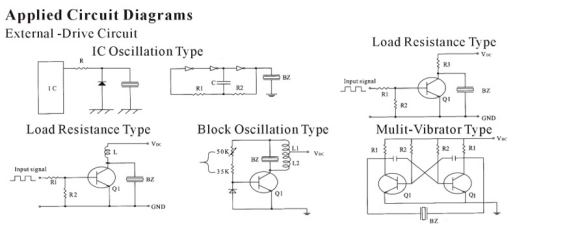
· Piezo Indicators (Self-Drive): These feature a built-in internal drive circuit. When a DC voltage is applied, the buzzer sounds at a fixed frequency. These are ideal for simple warning systems where ease of integration is paramount.
2. Driving a Self-Drive (Internal Drive) Buzzer
Driving a self-drive buzzer like the HYDZ D23H series is straightforward. Since the oscillation circuit is internal, you only need to provide the rated DC voltage.The Transistor Switch Method
While you can technically power a small buzzer directly from a high-current MCU pin, it is best practice to use a transistor (BJT or MOSFET) as a switch to prevent noise from feeding back into the microcontroller's power rail.· Key Components:
· NPN Transistor (e.g., S8050): Acts as the switch.
· Base Resistor (1kΩ - 4.7kΩ): Limits current to the transistor base.
· Flyback Diode: Although piezo elements are capacitive rather than inductive (unlike magnetic buzzers), a parallel diode or a small capacitor is often used to suppress voltage spikes during rapid switching.
3. Driving an External Drive (Transducer) Piezo
For transducers, the circuit complexity increases because you must provide an AC-like square wave.A. The Single-Ended Drive (Basic)
Using a single PWM pin and a transistor is the most common method. The MCU generates a square wave at the buzzer’s Resonant Frequency (typically 2kHz to 4kHz for HYDZ products).Critical Tip: Always include a pull-down resistor parallel to the piezo element. Because a piezo acts like a capacitor, it can hold a charge; the resistor ensures the charge dissipates, allowing the ceramic diaphragm to return to its neutral position for the next cycle.
B. The Push-Pull Drive (Enhanced Volume)
If the sound output is too quiet, hardware engineers use a push-pull configuration (using two MCU pins or a dedicated bridge driver). By driving one side high while the other is low, you effectively double the peak-to-peak voltage across the piezo, resulting in a significantly higher Sound Pressure Level (SPL).4. Maximizing Sound Pressure Level (SPL)
Overseas clients often ask: "Why is the buzzer quieter than the datasheet specs?" The answer usually lies in frequency matching.Every piezo element has a Resonant Frequency. Driving the buzzer even 100Hz away from this point can result in a 10dB drop in sound. At HYDZ, our automated production ensures tight tolerances on resonance, but the engineer must ensure the software's PWM frequency matches the component's specific datasheet value (e.g., 2700Hz).
5. Reliability and Environmental Considerations
When sourcing components for industrial or automotive applications, durability is non-negotiable. Our IATF16949 and ISO9001 certifications reflect our commitment to these standards.· Voltage Stress: Ensure your peak-to-peak voltage does not exceed the maximum rating, which can cause mechanical fatigue in the ceramic layer.
· Mounting: For SMD types, ensure the reflow profile matches the component's heat tolerance to avoid de-poling the piezo ceramic.
· Washability: Many HYDZ active buzzers come with a "Remove after washing" label. This protective seal prevents cleaning fluids from entering the acoustic cavity, which would dampen the sound or corrode the internal leads.